
How to Choose the Right Business Card to Represent Your Business
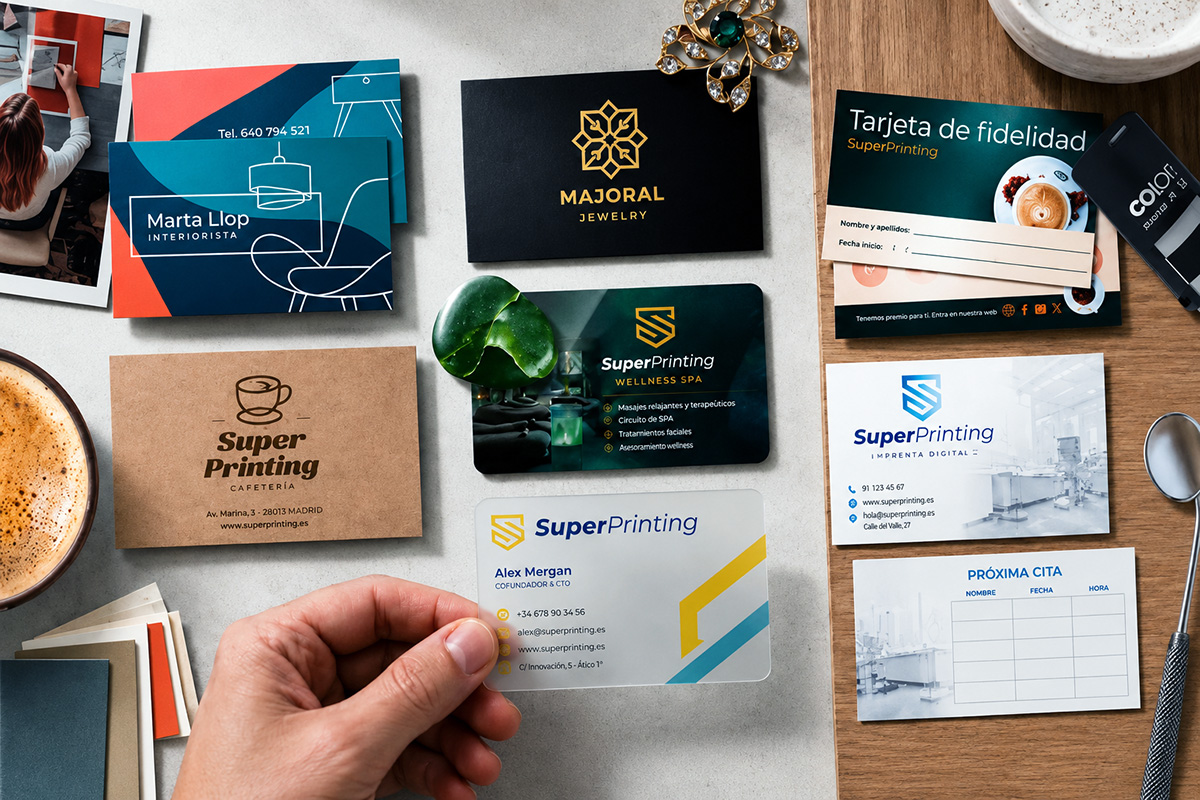
Discover the best business card materials and finishes to strengthen your brand and choose the perfect option for your business.
SuperPrinting Imprenta Online y Servicio de Diseño Gráfico
Publicado el lunes, 29 de junio de 2026 a las 10:24
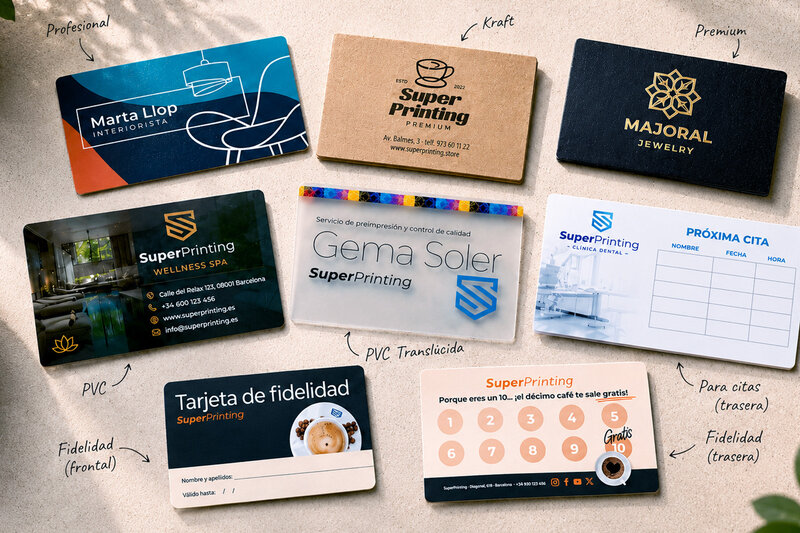
How to choose the right business card to represent your business
The material, finish and design of a business card influence how clients and partners perceive a brand.
In an increasingly digital environment, the business card remains a useful tool for introducing a company, making it easier to get in touch and strengthening brand identity. It is used at meetings, sales visits, trade fairs, conferences, business premises and professional events, where it allows essential information to be shared quickly and personally.
However, not all business cards convey the same image. The type of paper, thickness, texture, finish and layout can communicate professionalism, exclusivity, creativity, sustainability or modernity even before the recipient reads the contact details.
For this reason, choosing a business card should not depend solely on its price or appearance. It is important to consider the industry, the company's target audience, the personality of the brand and how the card will be used on a daily basis.
The business card as an extension of brand identity
A business card is much more than a surface on which to place a name, telephone number and email address. It is also a small physical representation of the company.
A consultancy firm may need a clean, understated card that inspires trust. An artisan coffee shop may benefit from kraft paper that conveys warmth and authenticity. A luxury boutique may use metallic finishes to reinforce its positioning. A technology company, meanwhile, may choose translucent materials or minimalist designs to project innovation.
The best choice is not necessarily the most expensive or eye-catching option. It is the one that remains consistent with the business activity and the image the company wants to convey.
Professional business cards
Professional business cards are a versatile solution for companies, self-employed professionals, retailers and specialists who need a practical card for everyday use.
Coated papers reproduce colours, logos and text with good definition. They can also be enhanced with matte lamination to provide greater consistency, protection and a more refined feel.
This option is particularly suitable for business meetings, client visits, corporate events and networking activities. Its main advantage is that it offers a good balance between presentation, durability and budget.
> > View professional business cards
Kraft business cards
Kraft paper is easily recognised by its brown colour and natural texture. It is an interesting alternative for projects that want to communicate warmth, sustainability, authenticity or handcrafted quality.
It can work particularly well for coffee shops, bakeries, florists, small retailers, food brands, natural cosmetics companies, creative workshops and businesses associated with eco-friendly products.
When designing a kraft business card, it is important to remember that the colour of the material affects the final printed result. Colours may appear darker or less intense than they would on white paper. In addition, white areas in the design will normally retain the natural colour of the paper unless specific white-ink printing techniques are used.
For this reason, simple designs with strong contrast and a limited colour palette often produce the most effective results.
Premium business cards
Premium business cards are intended for brands that want to reinforce an exclusive image and pay particular attention to the experience they offer their clients.
They can be produced using heavier-weight cardstock and combined with finishes such as matte lamination, spot UV varnish, embossing or metallic details in gold, silver, copper or rose gold.
This type of card is suitable for boutiques, jewellery stores, hotels, private clinics, architecture studios, professional firms, beauty brands, fashion labels and high-value services.
However, special finishes should be used in moderation. Highlighting the logo or a small design element is usually more elegant than applying effects across the entire surface.
> > Personalise premium business cards
PVC business cards
PVC business cards offer greater resistance than conventional paper cards. They withstand frequent handling, friction and certain environments in which paper could deteriorate quickly.
They are suitable for gyms, sports centres, swimming pools, spas, clubs, associations and businesses that also use the card as a form of member or customer identification.
In addition to its durability, PVC conveys a modern and solid image. However, before choosing it, a company should consider whether this material is consistent with its values and the message it wants to communicate.
Translucent business cards
Translucent business cards create a semi-transparent effect that helps them stand out from traditional formats. They are often associated with concepts such as innovation, creativity, technology and contemporary design.
They can be an interesting option for startups, design studios, creative agencies, photographers, architects, technology companies, fashion brands and beauty centres.
The design must be prepared with the transparency of the material in mind. An overly complex composition may lose legibility, while minimalist designs with fewer elements and clear typefaces usually make better use of the material's characteristics.
> > Personalise translucent business cards
Loyalty cards and appointment cards
Not every card has to be limited to presenting a company's details. Cards can also perform a practical function within the customer relationship.
Loyalty cards supplied in a pack with a self-inking stamp allow customers to collect points or visits in exchange for a reward. They are commonly used in coffee shops, restaurants, retail businesses, hair salons, beauty centres and other companies that want to encourage repeat purchases.
Personalised appointment cards, meanwhile, help customers remember the date and time of their next visit. They are particularly useful for clinics, dentists, physiotherapists, veterinary practices, psychologists, hair salons and professionals who work by appointment.
Adding a specific practical purpose increases the likelihood that the customer will keep the card for longer.
What information should be included?
A business card should provide the necessary information without appearing cluttered. The most common details include:
- Name of the person or company.
- Job title or professional specialism.
- Telephone number.
- Email address.
- Website.
- Physical address, when relevant.
- Professional social media profiles.
- A QR code linking to the website, catalogue, digital menu or booking system.
It is not necessary to include all these elements. The selection should be based on the purpose of the card. Too much information can reduce legibility and make it more difficult for the recipient to identify the most important details.
Mistakes to avoid
One of the most common mistakes is using text that is too small in order to include more information. It is also common to use decorative typefaces that are difficult to read, leave too little space around the text or place the QR code too close to the edge.
Another problem arises when a material is chosen solely for its originality without checking whether it matches the identity of the business. A card can be visually attractive while still conveying an image that is inconsistent with the company.
Telephone numbers, addresses, email addresses and links should also be checked carefully before sending the artwork to print. A small mistake can make the entire print run unusable.
A decision that should be guided by strategy
Before printing, a company should ask itself three questions: what image does it want to convey, where will the cards be handed out and what does it expect the recipient to do?
When the aim is to make contact easier during professional meetings, a clear and durable card may be sufficient. When the objective is to reinforce an exclusive brand experience, premium paper and a special finish may be advisable. When the card will be exposed to frequent use, PVC can provide greater durability.
Ultimately, an effective business card combines design, legibility, material and usefulness. When these elements are developed consistently, a seemingly simple item can become a communication tool capable of strengthening brand recognition and trust.
"This guide to the different types of business cards includes examples, (in spanish) materials, finishes and recommendations for different business sectors. The comparison covers professional, kraft, premium, PVC, translucent, loyalty and appointment cards."
You can also discover other printing and personalisation solutions for businesses on the SuperPrinting website.
29/06/2026 10:24 | DavidGar
SuperPrinting Imprenta Online y Servicio de Diseño Gráfico
URL oficial/canónica: https://paginasnaranja.emprenemjunts.es/?op=8&n=37033